
To me, a peach picked fresh from the tree is one of nature’s most perfect foods. One of my fond summer memories from childhood is eating ripe, juicy peaches from my grandfather’s large garden, still warm from the sun, peeled, sliced, and sprinkled with sugar. This recipe for low sugar peach jam captures that flavor perfectly, so you can feel like you’re enjoying fresh summer peaches any time of year.
This low sugar jam recipe lets the fresh fruit flavor shine through. It contains only four simple ingredients: peaches, sugar, lemon juice, and low sugar/no sugar pectin.

Low Sugar Peach Jam
I always make homemade peach jam when local peaches are in season, which could be any time from early to late summer depending on where you live. Use yellow-fleshed peaches for this jam; do not substitute white peaches for water-bath canning. Clingstone peaches work well, though freestone peaches are easier to pit. They tend to be soft, sweet, and juicy, with a classic “peachy” flavor and color. If you want to make peach jam when peaches are not in season, you can use frozen peaches. Let the peaches thaw before using them in the recipe.
For each batch of low sugar peach jam, you will need about 3 1/2 pounds or 10-12 medium peaches. This recipe yields six half-pint jars of jam.
Choose peaches that are ripe, but not overripe. If you pick them up and smell them, they should have a beautiful peach fragrance. They should be soft and yield slightly if you press them with your thumb, but they shouldn’t be mushy or have obvious brown spots.
Once you’ve selected the best fruit possible, it’s jam making time! Making homemade peach jam is easy, but you will need a little bit of canning equipment:
- Water bath canner with canning rack
- 1/2 pint Mason jars with lids and rings
- Jar lifting tongs
- Canning funnel
- Magnetic wand for retrieving lids from hot water (optional)
You can find the jars, rings, canners and all the equipment at stores like Walmart or many grocery stores, or you can order a canning kit, like this Ball Enamel Water Bath Canner with Utensils
You will also need some of your regular kitchen equipment for this recipe:
- Colander
- Potato masher
- Large, open pot, like a soup pot, for boiling the jam
- Wooden spoon or heat-proof silicone spatula, for stirring
- Large spoon for skimming
- Large liquid measuring cup
- Dry measuring cups and spoons
- Ladle
- Small ceramic plates
- Clean kitchen towels
Before you begin, inspect and wash 6-7 half-pint Mason jars. Run your finger around the rim of each jar to make sure it’s not chipped. A chipped jar won’t seal properly. After you inspect the jars, wash them in the dishwasher, or by hand with hot soapy water. Set the clean jars aside on a drying rack or clean kitchen towel.
Prepare the jars and lids
For any boiling-water process shorter than 10 minutes, presterilize empty jars by boiling for 10 minutes below 1,000 feet, adding one minute per additional 1,000 feet. Keep jars hot until filling. A dishwasher wash alone is not enough for that short process. See NCHFP jar-sterilizing guidance. Follow the lid manufacturer’s preparation instructions.
Once the jars are clean, put 2 small ceramic plates in the fridge, because you will need those later for testing the jam.
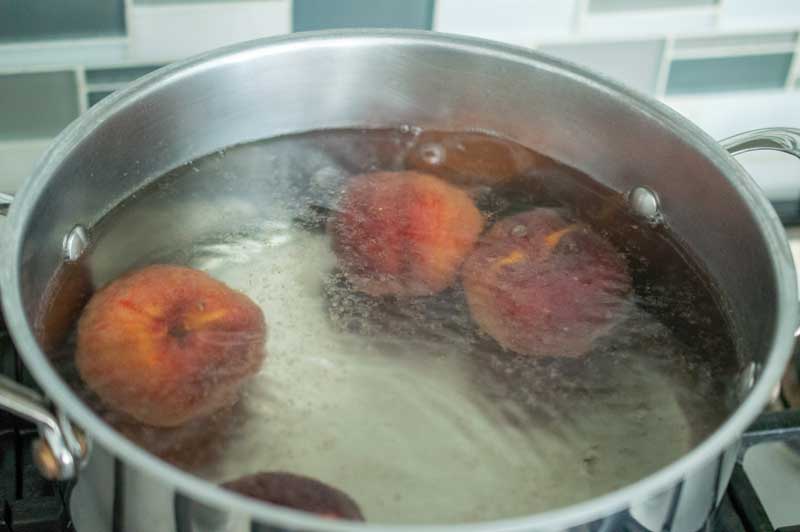
After you wash the jars, you will need to peel and chop the peaches. Peeling peaches is a bit of a chore. You can loosen the skin and make peaches easier to peel by blanching them quickly in boiling water, then dunking them in ice water.
Place 4-5 peaches at a time in a boiling water bath for one minute:
Low Sugar Peach Jam Ingredients
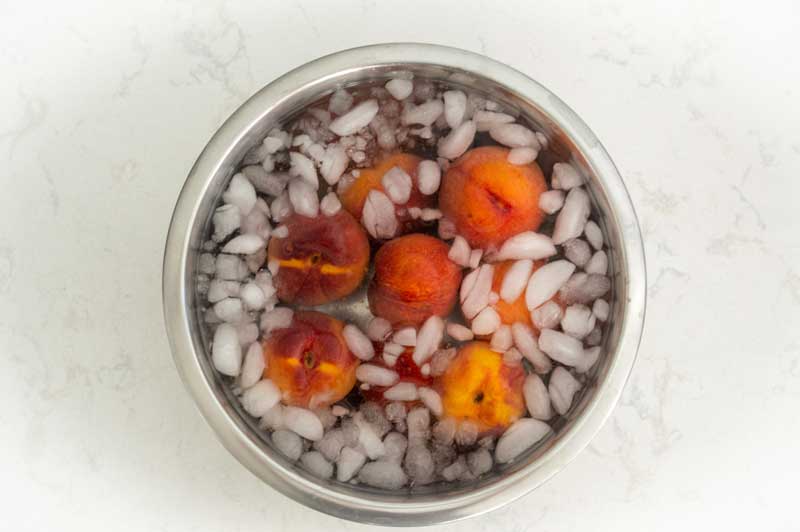
Remove the peaches from the boiling water with a slotted spoon, then place them immediately in a bowl of ice water for 1-2 minutes.
Low Sugar Peach Jam Ingredients
After the peaches have been blanched this way, you should be able to remove the skin easily with a paring knife. Cut the peaches in half and remove the pit, then remove the skin.

Low Sugar Peach Jam Ingredients
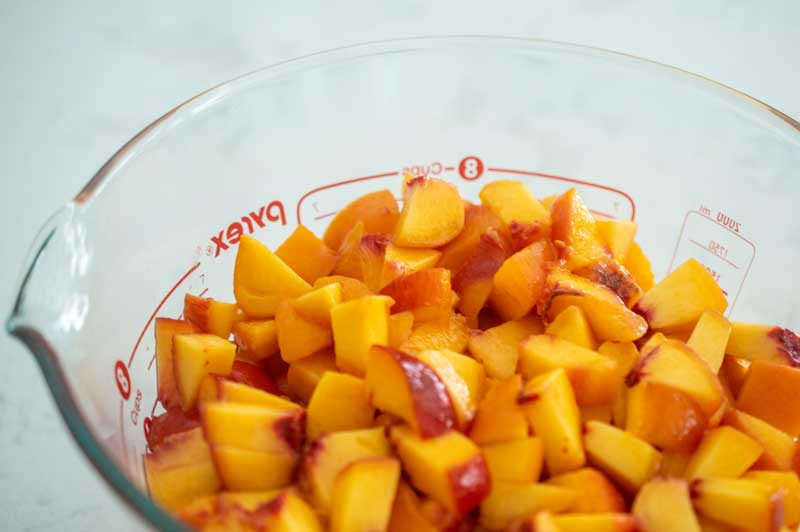
The next step is to roughly chop the peaches into about 1/2-inch pieces. You will need about eight cups of chopped peaches in order to end up with about five cups of mashed peaches for this low sugar peach jam recipe.
Low Sugar Peach Jam Ingredients
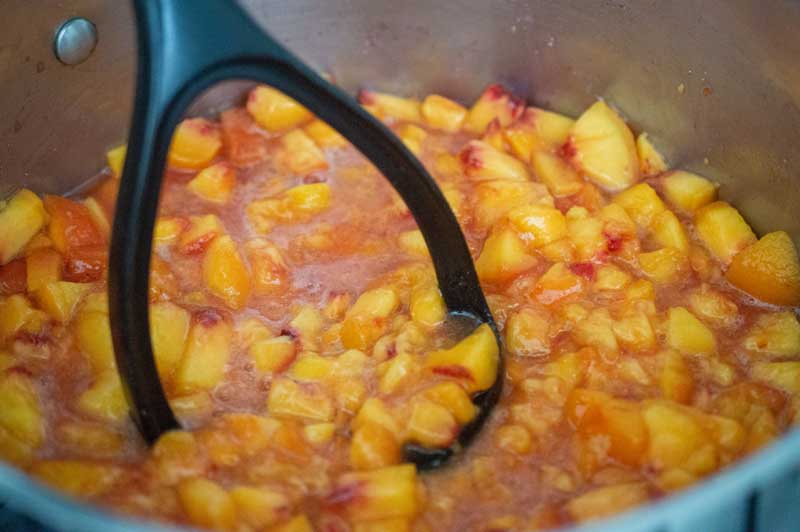
Using a potato masher, mash the peaches to a consistency you like. The great thing about making your own jam is you can make it whatever consistency you want. If you want a smooth and not chunky jam, you can use a food processor or immersion blender to puree the fruit. I usually stick with a potato masher. You can mash the fruit both before and during cooking.
Low Sugar Peach Jam Ingredients
If you want to make multiple batches of jam, I recommend making them one at a time. Doubling or tripling jam recipes will sometimes affect the cooking process and prevent the jam from jelling.
Which pectin should I use?
Use pectin specifically labeled for low- or no-sugar recipes. Regular pectin is not a direct substitute, and a box from one brand is not necessarily equivalent to three tablespoons from another. For shelf-stable canning, follow a tested recipe matched to the exact pectin product, including its fruit, sugar and acid proportions and processing instructions. Low-sugar pectin helps the jam gel with less sugar; it does not make jam mold-proof.
Mix the fruit, lemon juice, pectin and 1/4 cup of sugar in a large soup pot, and bring that to a full boil. Then add the rest of the sugar to total 3 1/2 cups, and bring it back to a full boil for one minute. A full boil, also called a hard boil, is a boil that doesn’t go away when stirred. Stir the jam the entire cooking time so it doesn’t burn.
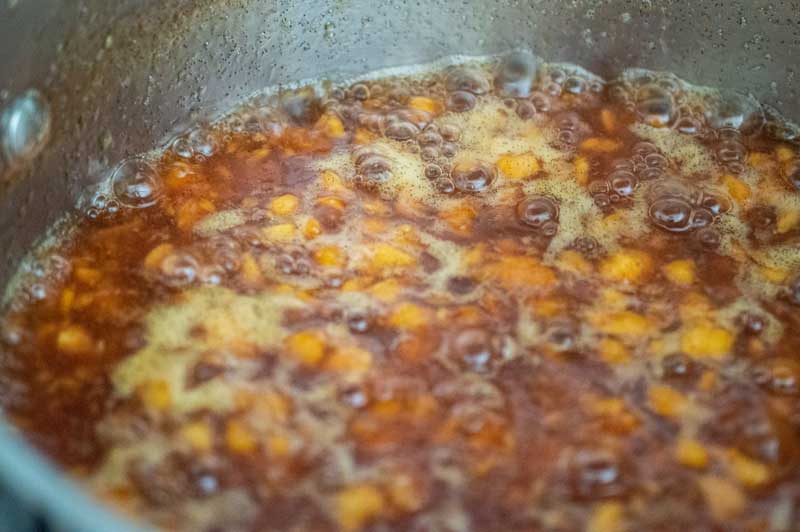
Low Sugar Peach Jam Ingredients
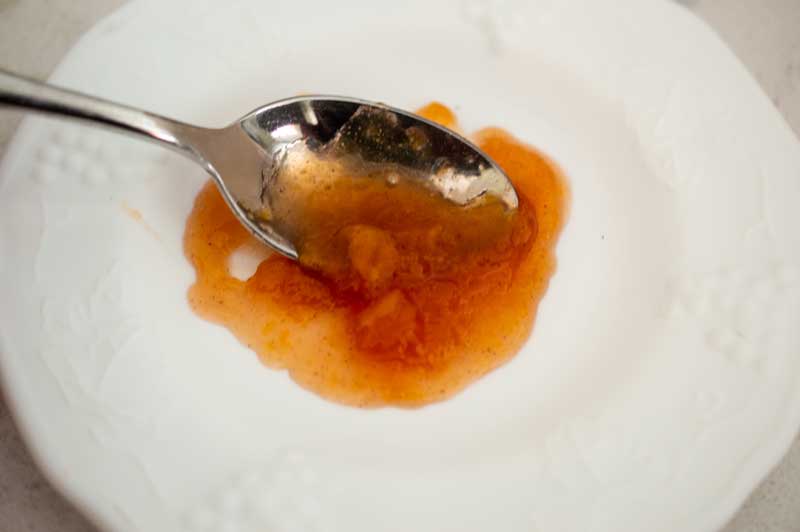
Once the jam has come to a hard boil a second time for a full minute, you can test its texture. Remove the jam from the heat, and take one of the cold plates out of the fridge. Pour a small spoonful of jam on the cold plate. If the jam thickens up to a texture you like, it’s done.
Jam continues to set as it cools. If a cooled batch remains too soft, use the pectin manufacturer’s tested remake directions rather than guessing at an extra amount of pectin.
Low Sugar Peach Jam
Once the jam is cooked, skim off the foam and stir gently to distribute the fruit. Keep the jam and jars hot for filling. Prepare clean lids according to the manufacturer’s instructions; do not let the jam stand and cool for 10 minutes before packing.
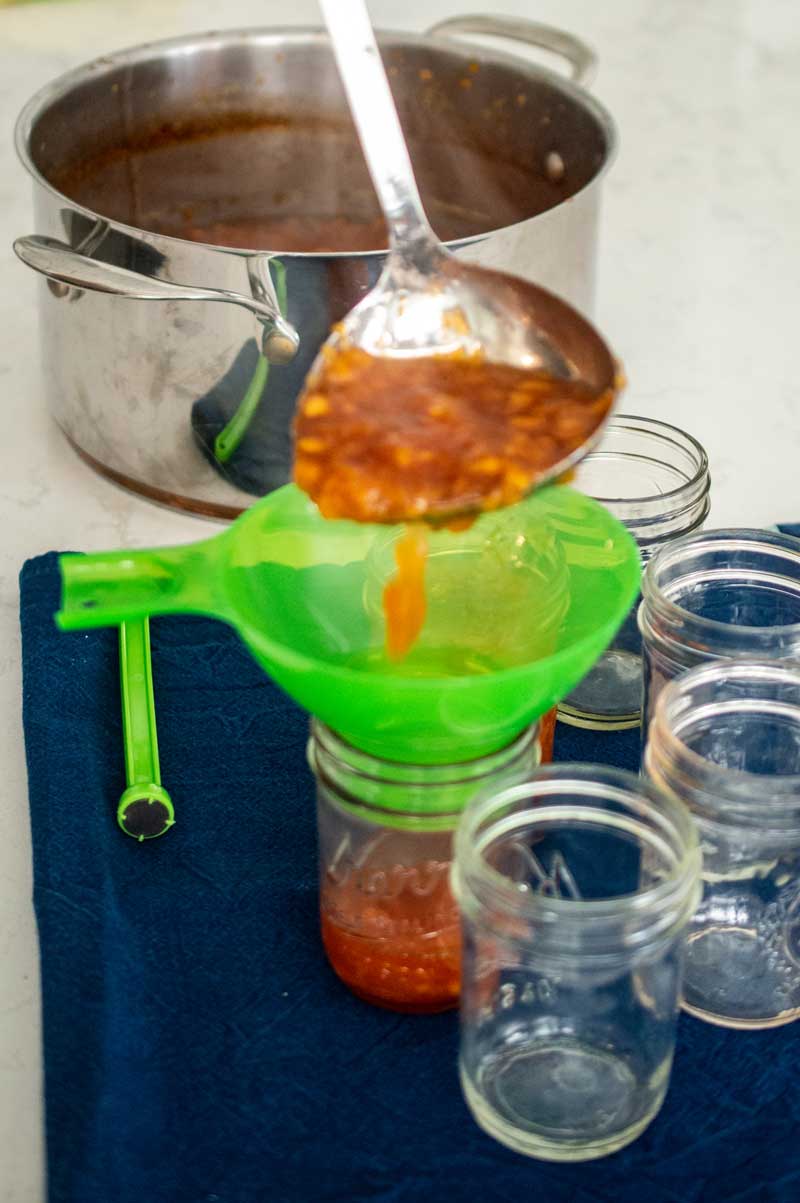
Fill the jam jars using a ladle and canning funnel. Make sure to leave about 1/4 inch of “headspace,” or empty space, at the top of the jar, in case the food expands during processing.
Low Sugar Peach Jam
Wipe off the rims of the jars with a clean towel. Place the lids on the jars and secure with rings, but don’t screw the rings on too tight.
Place the rack inside the water bath canner and fill with water. Place the jars carefully in the canner. The water should cover the tops of the jars by at least one inch. Follow the directions that come with your water bath canner.
For shelf-stable storage, use a tested recipe matched to your specific pectin, with its jar size and altitude-adjusted processing time. The original generic pectin measure does not confirm that the proportions match every current product. If you cannot confirm a matching tested formula, cool promptly and refrigerate or freeze the jam. For properly processed jars, follow the canner’s cooling directions, leave the jars undisturbed for 12–24 hours, then check the seals. See Ball’s low-sugar peach jam recipe for a tested product-specific option; its ingredient proportions differ from this recipe.
Making your own low sugar peach jam is totally worth the effort! Homemade peach jam also makes a great gift. Give it a try and let me know how it turns out!
Low sugar peach jam questions
Is this sugar-free jam or peach jelly?
No. This recipe contains 3 1/2 cups of added sugar and uses mashed fruit, so it is peach jam rather than clear peach jelly. It is not a no-sugar-added recipe.
Can I use frozen peaches?
Yes. Thaw them before mashing and measure 5 cups of prepared peaches. Frozen slice sizes vary, so use the mashed-fruit measurement rather than relying only on the volume of frozen slices.
How should I store it?
Only jars made and processed with a matching tested canning formula belong in the pantry. Refrigerate after opening. Lower-sugar spreads may lose quality sooner than full-sugar jam; discard the whole jar if you see mold or other spoilage. See NCHFP storage guidance.
For another fruit flavor, try low sugar raspberry jam or low sugar strawberry jam.

Low Sugar Peach Jam
Ingredients
- 3 1/2 pounds ripe fresh peaches (to substitute frozen peaches, see notes)
- 3 1/2 cups white sugar
- 1 box low/no sugar pectin or 3 tablespoons bulk low/no sugar pectin
- 1/4 cup lemon juice fresh or bottled
Equipment
- 6 half-pint Mason jars with lids
- Potato masher
- Ladle
- Large wooden spoon or silicone spatula for stirring
- Large wide pot like a soup pot for cooking
- Water bath canner
- Canning funnel
- Jar lifting tongs
Instructions
- Wash and inspect six half-pint canning jars. For a processing time under 10 minutes, sterilize empty jars in boiling water for 10 minutes below 1,000 feet, adding 1 minute for each additional 1,000 feet of elevation. Keep jars hot until filling; a dishwasher wash alone is not sterilization for this short process. Prepare lids according to their manufacturer. Chill two small ceramic plates for checking the jam.
- Blanch the peaches, 4-5 at a time, in a boiling water bath for about 1 minute. Remove with a slotted spoon, and immediately place in a large bowl of ice water. This will loosen the peach skins.
- Remove the peaches from the ice water and drain. Cut the peaches in half, remove the pits, and remove the skins with a paring knife.
- Cut the peaches into about half-inch chunks. You will need about 8 cups of chopped peaches.
- Mash the peaches with a potato masher until you get the texture you want for your jam. You should have about 5 cups of mashed peaches. You can also use a food processor or immersion blender for a smoother mixture.
- Mix the pectin, lemon juice, and ¼ cup sugar in a small bowl or measuring cup.
- Place the peaches in a large cooking pot, and add the pectin mixture. Over medium high heat, bring everything to a full boil that does not go down when stirred. Stir the entire time so the jam does not burn.
- Add the remaining sugar, stir well, and return the jam to a full rolling boil for one minute, stirring constantly. Remove from the heat. A spoonful on a cold plate gives an early indication of the texture, but the jam will continue setting as it cools. Do not add extra pectin at random; follow the pectin manufacturer’s tested directions for remaking a soft batch.
- Skim off foam. Keep the jam hot for filling; gently stir to distribute the fruit. Have clean lids ready according to the lid manufacturer’s directions. Do not leave the jam to cool before packing it into hot jars.
- Fill your jars, using the ladle and funnel, leaving 1/4 inch of clearance space at the top of the jar.
- Wipe the rims of the jars with a clean, damp towel. Place the lids on the jars and secure with rings. Do not screw the rings on too tight.
- For shelf-stable storage, use a tested peach-jam recipe matched to your specific low/no-sugar pectin, including its ingredient proportions, jar size, headspace and altitude-adjusted processing time. Pectin brands and package sizes are not interchangeable. Do not assume this older recipe’s generic box-or-tablespoon measure establishes a tested canning formula. If you cannot confirm a matching tested formula, cool promptly and refrigerate or freeze the jam instead of storing it in the pantry.
- For jars processed using a matching tested canning formula, turn off the heat, remove the canner lid and wait 5 minutes before lifting the jars upright onto a towel. Cool undisturbed for 12–24 hours, then check seals and remove the bands. Refrigerate unsealed jars promptly. Label and store properly processed, sealed jars in a cool, dark, dry place; use within a year for best quality. Refrigerate after opening and discard the entire jar if mold or other spoilage appears.
Notes
For more recipes like this one, follow us on Pinterest, follow us on Twitter or like us on Facebook.
Photos by Marsha Maxwell, Abramova Elena/Shutterstock.com.


I’ve finally found my peach jam recipe! Thank you for such detailed instructions, my jam set up perfectly (I used the 3 tbsp. bulk pectin if it matters). It does require patience to get to that rolling boil, but so worth it! This recipe made 7.5 half pints for me (I measured exactly 3.5 lbs of peaches with a scale). Delicious!
Thanks so much for the feedback, Aubree! Enjoy your peach jam!
Help! My jam didn’t set and in the mid of the night I realized I had missed 1/2 cup of sugar. Its already been sealed. Can I pour it all back into a pot and add the remaining sugar?
Hi Kelly,
If you unseal and add the sugar to your jam, you’ll want to re-sterilize the jars again before refilling them, but yes, it should work. Otherwise, you can always just add a little honey to whatever you eat your jam with to add some extra sweetness. Hope this helps!
I prepared recipe because the picture looked like jelly and not peach butter as other lower sugar jelly’s look. The taste is perfect it tastes like sweet peaches. I have a new recipe, a messy kitchen, sticky floor and more work to do. 80 peaches. What was I thinking!
Loretta – I’m so glad you liked the recipe, hopefully the mess was worth it 🙂
Great recipe! Easy to follow and turned out great! Made just short of 6 cups for me. (Maybe I didn’t leave enough head space in each jar.) THANKS!
Hi Pam, that’s great to hear, and thank you for your kind words. Every batch comes out a little different depending on the fruit, so I’m sure you didn’t do anything wrong.
I’m so glad I found this recipe! It is perfect! I love tasting “fresh peach” instead of tons of sugar! Thank you thank you for sharing!
Hi Rachel – I’m so glad you love the jam. I agree, so much fresh peach flavor.
I’m excited to try this recipe! Can I use pint size jars? Would I need to process longer…do you know how much?
Hi Lisa – great question. Yes, I think you would need more processing time. Here’s an article that may help you: https://winnebago.extension.wisc.edu/files/2010/09/Safe-Preserving-Jams-Jellies-now-in-PINT-jars.pdf